
When Buyers Know as Much as Sellers: The Quiet Collapse of Information Asymmetry
Aug 21, 2026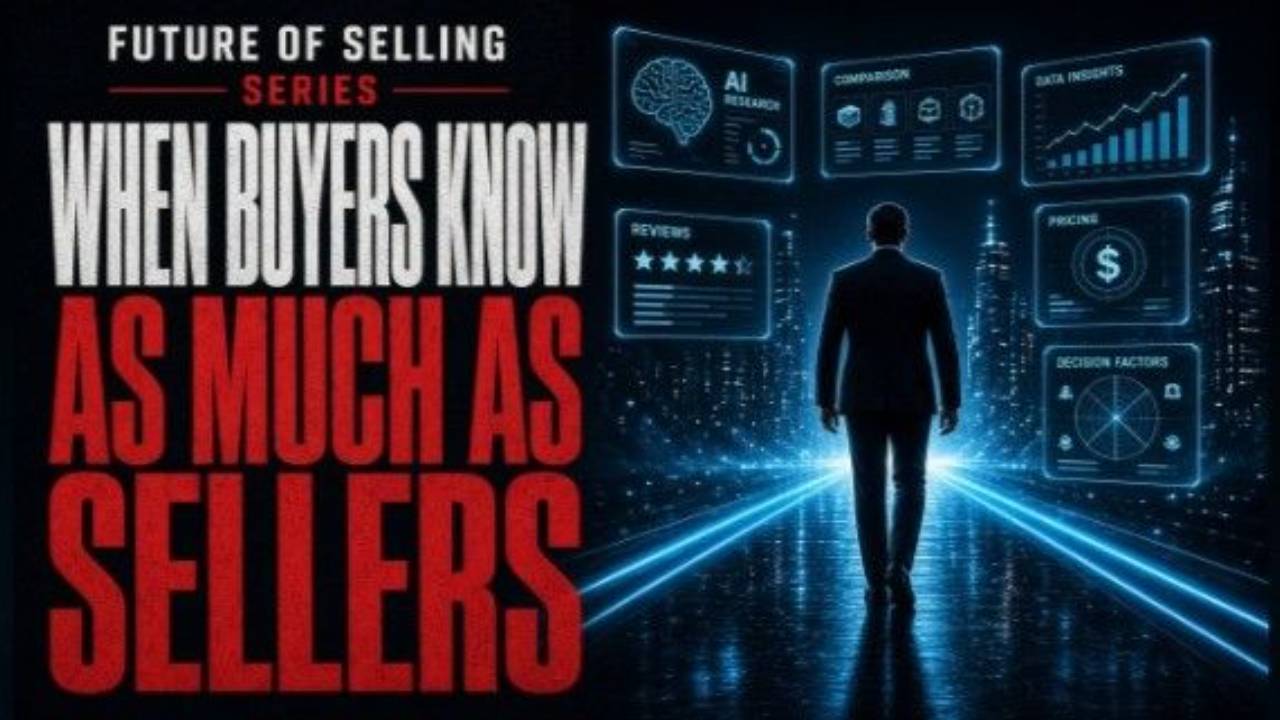
What happens to selling the moment the buyer knows as much as you do or more?That is the only question that matters now. Everything else is secondary. For more than 100 years, selling has rested on a single structural advantage called information asymmetry.
Information asymmetry is the condition in which one party in a transaction possesses significantly more relevant knowledge than the other.
The seller knew the product deeper, saw more competitive deals, understood implementation risks the buyer had never faced, and controlled the sequence and framing of that knowledge. We used this imbalance to:
- educate
- challenge,
- guide, and
- ultimately to shape the buyer’s perception of value and risk.
The entire modern sales process, from discovery to close, was designed around the assumption that the seller started with superior information and the buyer needed us to close the gap. And, it worked because human buyers have:
- limited time,
- limited attention, and
- limited capacity to process competing data.
They (the buyers) outsourced part of their thinking to the salesperson.AI is Changing a 100-Year-Old Model
When I wrote 'Sales Ex Machina: How AI is Changing the World of Selling' in 2017, 5 years BEFORE ChatGPT, very few believed AI would do so! Today, many now believe the impact will be real!

Last year, I wrote, 'Future of Selling, The Rise of AI Agents'. It's happening! We are now seeing AI agents being used effectively for 'definable tasks' with great success.

Here's my new prediction for the world of selling. By 2030, these AI agents will be standard equipment. And before the first human conversation between seller and buyer,
- The AI agent will have already ingested every public specification,
- every pricing pattern across comparable deals,
- every public review
- every support complaint,
- every integration guide,
- every third-party benchmark, and
- every competitor’s published performance data.
It will have already modeled Return on Investment (ROI), Total Cost of Ownership (TCO), and flagged every inconsistency between marketing claims and real-world evidence. The research that once took a skilled salesperson weeks to assemble will be completed by the buyer’s side in minutes, without fatigue, ego, or selective omission.
Information asymmetry does not merely shrink. In many cases, it reverses. The buyer’s agent often arrives with a cleaner, broader, and more current data set than the individual salesperson possesses.
The New Information Strategy: Drip and Gating Are Dead
Marcus Sheridan. For years, through his book (They Ask, You Answer) and training, he has argued that information, especially pricing, should not be gated (i.e., a buyer has to call or ask for pricing via a contact form). His premise was simple: reduce buying friction!
The new AI reality is this. Any process built on controlling, gating, or sequencing information becomes theater. “Education-based selling” is redundant when the agent has already educated itself more thoroughly than most sales teams. Attempts to withhold, spin, or drip information are detected as signals of weakness or misalignment.
Worse yet, the AI agent feels no reciprocity when you share an insight. It grants no authority because you demonstrated product knowledge. It simply updates its model and continues optimizing for the buyer. Stop treating information control as a strategy.
Sales methodologies that teach people how to manage the information gap are training for a world that no longer exists. The gap is closing by pure computational force...one token at a time!They Want Your Alphas
Alex Karp, Chief Executive Officer (CEO) of Palantir Technologies, a major software company specializing in big data analytics and artificial intelligence, talks about 'Alpha'. Alpha refers to a company's secret sauce, proprietary edge, or unique competitive advantage.
That's it! The only remaining edge for any company is proprietary, non-public insight that the buyer’s AI agent cannot scrape:
- operational data from real deployments,
- case studies with tangible outcomes
- quantified risk patterns visible only from inside multiple customer environments, and
- predictive models built on outcomes that the company has not yet published.
The conversation must start at the edge of the known; something the AI Agent CAN NOT know. Companies that continue to rely on polished decks and selective storytelling will be systematically out-modeled by those that do not. Let me lay out two scenarios.
Scenario 1: Clueless About Agents- A software company runs a classic discovery process. The salesperson spends two meetings uncovering needs, then delivers a tailored demo highlighting three differentiators. But the buyer’s AI agent has already mapped those differentiators against six competitors, calculated the actual implementation difference from public case studies, and identified two lower-risk alternatives the salesperson never mentioned. Guided by the agent’s scoring, the human buyer doesn't commit. The deal stalls or dies. Worse yet, the salesperson believes the buyer “wasn’t ready” or “went with price.” The real cause was the collapse of information asymmetry that the seller either refused to acknowledge or was unaware of.
Scenario 2: Adapted Agent Approach - A different seller opens the first conversation by stating, “Your AI agent has already processed the public data. But here is the non-public performance distribution from our last forty deployments in environments that match your constraints. Here is the quantified risk reduction we can contractually stand behind.” The AI agent updates its model. The deal advances on clearer terms because the seller stopped competing on information the buyer already owned.
By 2030, that's approximately 3.5 years away, the world of selling will be transformed as I have described. I know,...you don't buy it or see it. I understand.
- The companies that treat the death of information asymmetry as a process redesign (Scenario 2) will still be selling five years from now.
- The ones that treat it as a messaging problem (Scenario 1) will be explaining why their pipeline collapsed.
Victor Antonio
p.s., Consider helping me out by pre-ordering my new book, "Priced to Win: The Sales Leader's Framework for Closing Deals Without Caving on Price" due out in Nov. 2026.

#ModernSelling #B2BSales #AIAgents #SalesLeadership #DigitalTransformation #BuyerJourney #SalesTraining #FutureOfWork #ArtificialIntelligence #ValueSelling #futureofselling