
What Tesla's FSD Can Teach Us About Selling - The Brain Doesn’t Price Things. It Compares Them.
Aug 26, 2026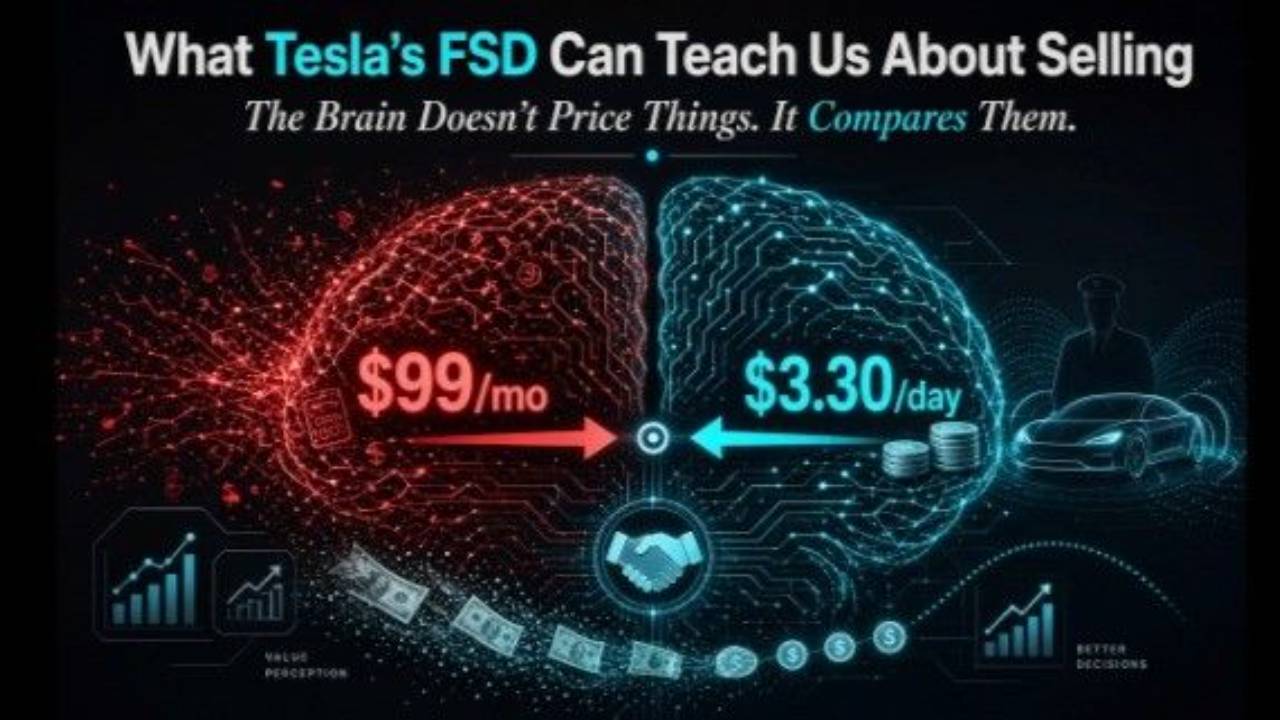
"That's more than I want to pay."
"I don't know if it's worth it."
"I don't know if I want to spend that much."
We've all heard these objections. And many salespeople still try to justify the price, which is why they lose. Truth be told, I used to do the same. I’d hear “that feels expensive” and start defending the number.
- I would start talking about the features, benefits and advantages.
- I'd drop in some ROI, BEP, or TCO numbers to build my case that it wasn't expensive.
- Offer a discount or extend financing.
And still, none of it worked. Why? Because the real problem wasn’t the price. It was the algorithm running in the buyer’s head that I never touched.
The brain isn’t a calculator; it's a 'risk-mitigating machine', looking for ways to minimize its risk. The brain runs an algorithm built for continuous comparison analysis. Absolute numbers mean almost nothing unless it has something to compare it to. It only scores relative position against whatever reference points are currently loaded. Daniel Kahneman and Amos Tversky mapped this decades ago.
- When a buyer says “$99 a month is expensive,” their algorithm isn’t doing math.
- It’s comparing the number to current habits or some vague sense of what feels high.
- Change the reference and the same number flips.
The brain isn’t a calculator; it's a 'risk-mitigating machine'
Tesla's Full Self-Driving (FSD) is the cleanest and most recent example of how changing the comparison can change a buyer's mind.
Example
My son-in-law has a Tesla. For a few years now, he's refused to buy Tesla's FSD subscription. Why? Because it's $99 a month. He's a software engineer who is accustomed to paying monthly subscriptions for various Software as a Service (SaaS) products.
Now, let's say I'm a Tesla sales rep and I want to convince him to buy the subscription. Again, in his mind, he's comparing it to his current SaaS products; he's probably thinking about the utilization he gets from these tools to justify the cost. The problem with the FSD subscription is that he's comparing it to SaaS products.
So, how would I sell him on buying it?
Strategy A: Use Reductio ad absurdum, which means reducing an idea (price) to the absurd (or the ridiculous) to expose how weak (cheap) it is. I could say, "Some people focus on $99 a month; I think about the fact that it's only $3.30 a day. At that price, I'm sure you see how having the subscription is worth it."
This strategy might work, but it's still in the LEFT hemisphere (logical side) of the brain. I need to give it more emotional weight.
Strategy B: Swap or replace his comparison frame (i.e., to SaaS subscription). Instead, I would say,
"Look, you're focused on $99 a month or only $3.30 a day. Let me ask you a question: "Who drives rich people around? Chauffeur is correct. Now, do you think it's possible to find and hire a reliable Chauffeur for $3.30?"
With that simple question, I shifted the conversation from “Is $99 expensive?” to “How does $99 compare to a full-time chauffeur?” Only the rich used to have that luxury; not any more. Now the same outcome runs about $3.30 a day. Once that comparison locks in, $99 stops feeling like a subscription and starts feeling like democratized luxury.
The brain’s algorithm handles small daily numbers with almost no resistance. $99 a month triggers pushback. $3.30 a day does not. Same money. Different data. That’s reframing at work. Tie it to a new reference point or comparison, and it makes it more compelling!
People don’t buy products. They buy the gap between their current state and a better reference.
Stop defending numbers. Start changing the comparisons the algorithm the buyer's brain is running!
Victor Antonio, author of "Priced to Win"
P.s., Consider pre-ordering my new book, "Priced to Win: The Sales Leader's Framework for Closing Deals Without Caving on Price," due out in Nov. 2026 with Wiley Harper Publications.