
The Monkey Trap:Why Salespeople Can't Let Go of the Discount
Oct 07, 2026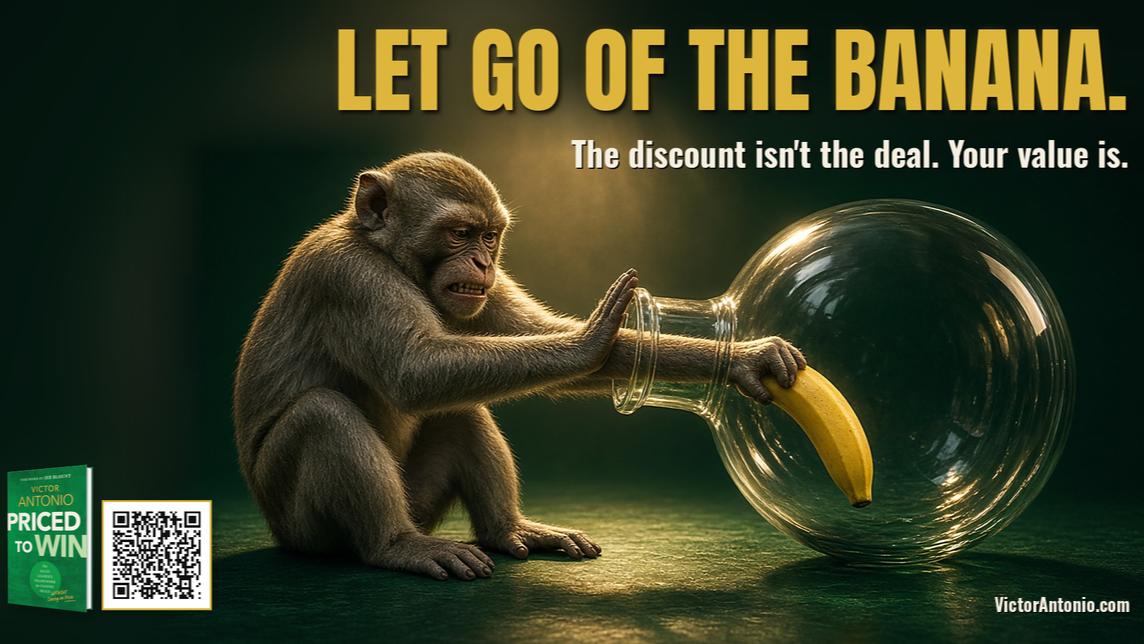
I'm sure you've heard the old story that hunters tell about catching monkeys.
They start by taking a jar with a narrow neck and tie it down. Then they drop something sweet inside. A banana. A handful of nuts.
A monkey smells it and reaches in. The opening is just wide enough for an open hand. The monkey grabs the treat and makes a fist.
Now the fist won't come out.
The hunter walks up. The monkey panics. It pulls, twists, and screams. All it has to do is open its hand, and it's free. It won't.
Lesson: The jar isn't holding the monkey. The monkey is holding the monkey. It's trapped by what it refuses to let go of.
I've watched a lot of salespeople reach into that same jar. The discount is the banana.
You know the moment. The buyer pauses. Maybe they say, "That's a little higher than we expected." Maybe they say nothing at all.
And the salesperson's hand goes straight for the discount. "I can probably get you 10% off." It feels safe. It feels like the thing that will close the deal. So they grab it and hold on tight.
But watch what happens next. The buyer now knows the price was soft. They ask for more. The rep gives a little more. The deal drags. Margin shrinks. And next year, the renewal starts from the lower number.
The rep isn't stuck because the buyer is tough. The rep is stuck because they won't let go of the belief that the discount is what wins.
That's the trap.
Most salespeople don't discount because they're lazy. They discount because they're afraid.
- Afraid of losing the deal.
- Afraid of missing the number.
- Afraid the buyer will walk to a cheaper competitor.
So the discount becomes a security blanket. In my new book Priced to Win, I make the case that discounting starts as a belief. Before a rep ever drops the price, they've already decided price is the reason people buy. It usually isn't.
People buy because they believe you'll solve a problem that's costing them money, time, or sleep. When you lead with a discount, you tell them the opposite. You tell them your value is negotiable.
As I write in the book: "Once you discount without resistance, you've shifted control to the buyer. You've taught them that price is negotiable."
Open your hand
Freedom for the monkey is simple. Open the hand.
Freedom for the seller is simple too. Stop gripping the discount, and start gripping the value.
That's the mantra of the book: Position your value, not your price. Here's what that looks like in a real conversation. Instead of: "I can do 10% off if you sign this week."
Try: "Before we talk about price, let's make sure we agree on what this fixes. You said downtime is costing you about $40,000 a month. If we cut that in half, the savings are obvious. Would you agree?"
Now the conversation is about the problem, not the price. The number on your proposal starts to look small next to the number on their pain.
In the story, the monkey loses everything because it wouldn't let go of something small.
Sales works the same way. Hold on to the discount, and you lose margin, respect, and control of the deal.
Let it go, and you get your hands back. Hands you can use to ask better questions, show real value, and close with confidence.
If you're ready to stop reaching for the banana, pre-order Priced to Win: The Sales Leader's Framework for Closing Deals Without Caving on Price (Wiley, November 9, 2026).
Victor Antonio
Pre-order: https://www.amazon.com/Priced-Win-Leaders-Framework-Closing/dp/1394454287