
How AI Is Helping Dentists Lift Treatment Acceptance ~30%
Sep 19, 2026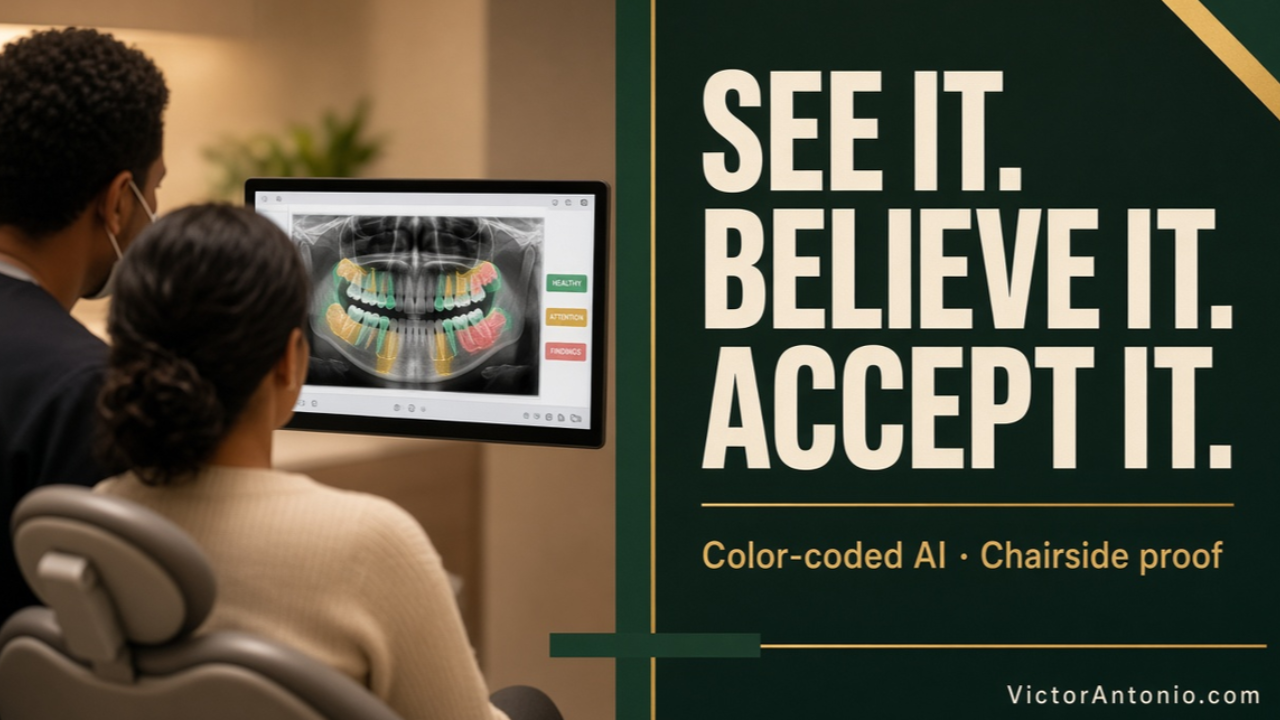
In doing research for an upcoming speaking and training event for a Dental organization, I came across another fascinating AI use case study on increasing close (acceptance) rates using visual proof and 'in-the-moment' conversations.
Most patients don't reject treatment because they can't afford it, as many dental practices have financing options.
They reject it because they're anxious, and when a dentist says, "Trust me, you need this," it isn't enough proof when someone's sitting in a chair staring at a gray X-ray they can't read.
And it's why AI that reads radiographs chairside is changing production numbers, not just clinical workflow.
Platforms like Pearl's Second Opinion are reporting something sellers should care about:
Practices using color-coded, chairside AI analysis are seeing treatment acceptance climb by about 30%.
Here's the main takeaway: That isn't a chatbot win, it's an influence win.
Picture is Worth a Thousand Words
For example, a bitewing (catch decay between teeth) or PA (show the whole tooth down to the root) means almost nothing to a patient. Dark spots. Shadows. A dentist pointing at a screen.
Color-coded analysis changes the conversation. Suspected bone loss or periapical issues get highlighted in clear overlays the patient can actually see. The finding stops being abstract and becomes visual evidence.
Article content
Persuasive X-Ray Imagery
Psychologically, anxiety drops when the brain can categorize risk. Green, yellow, red (or whatever the overlay system uses) turns "maybe later" into "I see it." It's not about "Trust me, I've done this for years," but walking the patient through proof.
In sales psychology terms, you just removed ambiguity, and ambiguity is what fuels delay.
Chairside is the lever. Timing is the close.
Here's where most practices leave money on the table: they find the issue, send the patient home with a printout, and hope the recall call lands.
AI that runs in under a minute while the patient's still in the chair flips that. The radiograph comes up. The AI marks findings. The dentist reviews and confirms. Then the conversation happens in the moment, with authority and evidence stacked together.
Authority: a licensed clinician plus an FDA-cleared second set of eyes trained on millions of labeled images.
Evidence: color overlays on the patient's own X-ray, not a brochure.
That isn't a hard sell; that's the beauty. The visual (X-ray) and the conversation in the moment. That's co-reading the proof. Influence research has been clear for decades:
People move when the messenger has credibility and the case is visible. Chairside AI is built for both.
Now, this isn't "AI replaces the dentist." Second Opinion-style tools are assistive: computer vision flags, the doctor decides.
You have cleaner patient conversations.
Fewer "I'll think about it" exits.
More accepted, billable care.
Front office and claims get easier
AI that acts like a radiologist in the room isn't a tech story. It's a treatment-acceptance story, and ~30% is the number worth measuring.
Victor Antonio, author of The Future of Selling